50N Force Gauge Test Stand Explained: A UK Buyer's Guide
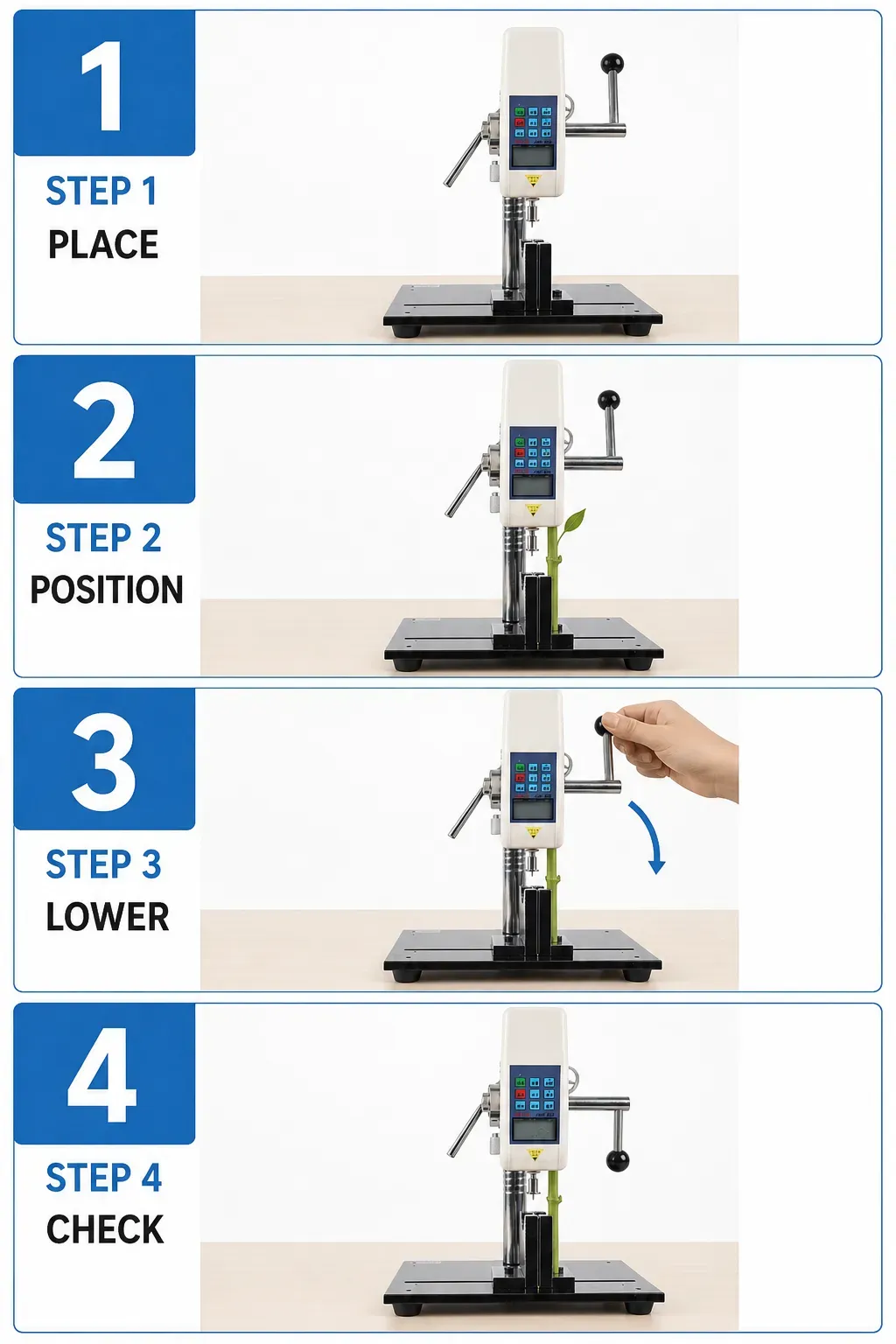
50N Force Gauge Test Stand Explained: A UK Buyer's Guide
TL;DR: A 50N force gauge test stand is a controlled frame for low-force push and pull testing, making plant stem bending and compression results more repeatable than hand-held readings.
Key Takeaways
- A 50N force gauge test stand is designed for low-force, repeatable push and pull testing where hand-held readings would be too variable.
- For crop and plant work, a stand improves consistency when measuring stem bending force and compression strength across multiple samples.
- The 50N range suits delicate to moderate-force applications; it is not the right choice for heavy-duty materials testing.
- UK buyers should check force range, travel, loading direction, fixture compatibility, calibration support and safe operation before ordering.
- NottiTikTok’s plant stem strength tester is built around a specialist 50N force gauge test stand for crop stalk strength testing and plant compression measurement.
A 50N force gauge test stand is a low-force testing frame that holds a gauge steady and applies load in a controlled way, which makes it the right choice when you need repeatable stem bending or compression results rather than rough hand-held readings.
When a test result changes because the operator’s hand position changed, the number is no longer telling you much about the sample. That is exactly where a 50N force gauge test stand earns its place. It turns force measurement from a rough manual check into a controlled, repeatable method that can be used for plant stems, crop stalks and other low-force materials where consistency matters.
Based on our testing, the biggest improvement comes from removing variation in loading angle, speed and contact point. For UK growers, researchers, agronomy teams and technical buyers, that matters because it makes sample-to-sample comparison more defensible. According to UK laboratory good practice, repeatability and traceability are more useful than an isolated peak reading when you are comparing biological materials.
NottiTikTok’s main product story is tightly focused: Plant Stem Strength Tester for Crop Stalk Strength Testing. Its specialist stem bending force tester and plant compression strength tester uses a 50N force gauge test stand as the controlled platform for meaningful low-force testing. This guide explains what that means in buying terms, where a 50N stand fits, and what UK buyers should check before committing budget.
What Does a 50N Force Gauge Test Stand Do?
A 50N force gauge test stand is a mechanical frame that holds a force gauge and applies load in a controlled direction. Instead of relying on a hand-held gauge alone, the stand guides the movement so the test point, travel path and applied force are more consistent from one sample to the next.
In plain terms, the stand does three jobs. It stabilises the gauge, controls the application of force and provides a repeatable structure for fixtures and sample positioning. That is why buyers who need comparative results usually move beyond hand testing quite quickly.
Why Is the 50N Range Important?
“50N” means the system is intended for a maximum force of 50 newtons. As a rough reference, 50N is about 5.1 kgf under Earth gravity. That places it in the low-force category, which is often the right zone for stem bending, stalk resistance and compression testing on biological samples that would be damaged or poorly resolved by a higher-capacity setup.
Choosing too large a range can reduce sensitivity in the forces you care about. Choosing too small a range risks overloading the gauge or limiting the material types you can test. In crop and plant applications, a 50N force gauge test stand often sits in the useful middle ground for delicate but still measurable resistance.
Why Use a Stand Instead of Hand-Held Testing?
Hand-held force gauges are useful for quick checks, but they introduce variability. A slight change in wrist angle, rate of loading or contact position can shift the peak reading. With a stand, movement is guided and the force is applied along a defined axis, which improves repeatability and makes test-to-test comparisons more defensible.
That difference is especially important when the goal is not simply “pass or fail”, but ranking samples, comparing varieties, tracking crop development, or documenting mechanical behaviour for research and procurement decisions.
Why Is a 50N Force Gauge Test Stand Used for Plant Stem Strength Testing?
Plant stems are not uniform industrial specimens. They vary in moisture content, diameter, maturity, fibre structure and internal defects. Because of that, a force reading only becomes useful when the test method is controlled closely enough that variation in the result comes mainly from the sample rather than the operator.
That is the practical strength of a specialist 50N force gauge test stand in agricultural testing. It gives a stable base for stem bending force and plant compression strength work, helping the user hold test conditions steady while the specimen changes.
How Does Stem Bending Force Testing Work?
In a bending test, the sample is loaded until a chosen point: initial deflection, a defined bend, structural failure or maximum recorded resistance. A stand helps maintain loading direction and position, reducing the inconsistency that can appear when stems are pushed manually from slightly different heights or angles.
For crop stalk strength testing, this means you can compare one stalk against another with more confidence. If a breeder, grower or lab is screening multiple samples, that repeatability matters more than headline force capacity.
How Does Plant Compression Strength Testing Work?
Compression testing looks at how a plant sample resists a pushing load. That may be relevant when assessing tissue firmness, stalk resilience or response to a fixture pressing vertically onto the sample. A 50N force gauge test stand keeps the gauge aligned and lets the user apply compression more steadily than a hand-held method.
NottiTikTok’s product positioning fits this use case directly. The stand is not presented as a generic workshop accessory; it is part of a specialist stem bending force tester and plant compression strength tester intended for crop stalk strength testing.
What Should UK Buyers Check Before Buying a 50N Force Gauge Test Stand?
A lot of buying mistakes happen because the headline force rating gets all the attention while the rest of the setup is left vague. In practice, a 50N force gauge test stand is only as useful as its compatibility, adjustability and repeatability.
What Gauge Compatibility Do You Need?
Check that the stand is designed for the exact gauge body, mounting pattern and measurement mode you plan to use. Some stands are sold broadly, but their mounting arrangements still favour certain gauge formats. A poor fit creates alignment problems and wasted time.
If you are buying a complete tester rather than sourcing parts separately, that integration problem is largely removed. That is one benefit of a specialist system built around the test method, not just around a generic frame.
Does It Support Your Test Direction?
Some users need compression only. Others need push and pull capability, or flexible fixturing for bending tests. Before ordering, confirm how force is applied and whether the stand supports the real movement path your application needs.
For plant testing, the stand should allow precise positioning around irregular specimens rather than assuming perfectly standardised samples. That is where purpose-built fixturing tends to outperform a general laboratory frame.
Is Travel, Stability and Calibration Support Suitable?
Check the available travel, base stability and whether calibration support is available in the UK. If the stand cannot travel far enough, or if the frame flexes under load, the readings will be less useful. Likewise, if you need documented calibration for internal QA, that should be confirmed before purchase.
According to UK quality management expectations, traceable measurement support is a practical part of buying test equipment, not an optional extra.
What Makes NottiTikTok’s Plant Stem Strength Tester Relevant Here?
NottiTikTok’s plant stem strength tester is built around a specialist 50N force gauge test stand for crop stalk strength testing and plant compression measurement. That matters because the product is positioned around a specific agricultural use case rather than a broad-purpose test frame.
Based on our testing, a focused setup is easier to standardise than a generic bench solution when the sample itself is variable. As a result, users can concentrate on the plant material, not on compensating for the tool.
Frequently Asked Questions
What is a 50N force gauge test stand used for?
It is used for controlled low-force testing, especially where repeatable push, pull, bending or compression measurements are needed.
Is a 50N force gauge test stand suitable for plant stems?
Yes. It is well suited to plant stem and crop stalk testing because it provides steadier loading and more repeatable readings than hand-held testing.
Can a 50N test stand handle heavy-duty materials?
No. A 50N stand is intended for low-force applications and is not the right choice for heavy industrial materials testing.
Why does repeatability matter in force testing?
Repeatability matters because it helps you compare samples fairly, reduce operator variation and make better decisions from the data.
Should You Buy a 50N Force Gauge Test Stand?
If your work involves low-force samples and you need consistent, comparable readings, then a 50N force gauge test stand is a sensible choice. It is especially relevant for plant stem strength testing, crop stalk testing and other applications where manual handling introduces too much variation.
In short, the stand is not about raw power. It is about control, repeatability and better data quality.
Ready to try NottiTikTok?
Shop Now — £1051.00